

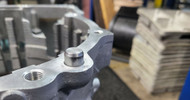
Why Alignment Dowel Pins Are Critical for 68RFE and AS69RC Transmission Installation
When installing a transmission, alignment dowel pins are one of the most overlooked and most critical components in the entire process. Ignore them or install them incorrectly, and you’re not just risking a minor issue. You’re setting yourself up for catastrophic failure.
This is especially true for two of the most common RAM diesel transmissions: the 68RFE and the AS69RC.
While both are highly sensitive to alignment issues, the AS69RC takes it a step further—where even slight misalignment can quickly lead to pump failure, torque converter damage, and total transmission loss.
Let’s break down why this happens and how to avoid it.
What Alignment Dowel Pins Actually Do
Alignment dowel pins are precision-fit metal pins located on the engine block or bellhousing. Their job is not to hold the transmission in place, that’s what bolts do.
Their job is to ensure perfect alignment.
They control the exact positioning of the transmission in relation to the crankshaft centerline, maintaining tolerances within thousandths of an inch. Manufacturers like ARP Fasteners emphasize that fasteners alone cannot maintain this level of positional accuracy.
Without dowel pins, the transmission can shift slightly off-center even if everything is torqued down correctly.
And that’s where problems begin.
Why Alignment Matters in RAM Diesel Transmissions
Both the 68RFE and AS69RC are designed to handle significant torque loads from Cummins diesel engines. That means internal components are under constant stress, even when everything is perfectly aligned.
When alignment is off, that stress multiplies in all the wrong ways.
Shared Risks Between 68RFE and AS69RC
Pump Failure
The transmission pump depends on precise alignment with the torque converter hub. Even slight offset causes:
- Uneven gear loading
- Pressure instability
- Rapid internal wear
Transmission specialists, including Sonnax, frequently identify misalignment as a root cause of premature pump failure.
Torque Converter Damage
A misaligned transmission forces the torque converter to operate off-center, leading to:
- Hub wear
- Bushing failure
- Overheating
- Cracked flexplates
This isn’t a slow failure, it can happen almost immediately after startup in severe cases.
Input Shaft and Bearing Stress
When alignment is off:
- The input shaft is side-loaded
- Bearings wear unevenly
- Internal components begin to fail prematurely
This kind of damage often shows up later but by then, the transmission is already compromised.
Why the AS69RC Is Far Less Forgiving Than the 68RFE
Here’s where things get serious.
While the 68RFE will absolutely suffer from poor alignment, the AS69RC is much less tolerant of even minor errors.
- Higher Torque Loads
The AS69RC is typically paired with higher-output Cummins configurations. More torque means:
- Greater force on internal components
- Faster escalation of misalignment damage
- Tighter Internal Tolerances
Modern transmissions are built for efficiency and performance. The AS69RC, in particular, operates with tighter internal clearances, leaving almost no room for error.
Even a few thousandths of an inch off-center can create immediate issues.
- Pump Sensitivity
The AS69RC pump is especially vulnerable to misalignment. When the torque converter hub isn’t perfectly centered:
- Pump gears experience uneven loading
- Cavitation can occur
- Hydraulic pressure drops rapidly
In many cases, this leads to immediate pump failure right after installation.
Real-World Failure Breakdown
Here’s what actually happens when dowel pins are missing, damaged, or ignored:
|
Failure Type |
Root Cause |
Typical Outcome |
|
Pump failure |
Off-center converter hub |
No line pressure, no movement |
|
Converter damage |
Misalignment during rotation |
Vibration, overheating |
|
Flexplate cracking |
Uneven load distribution |
Structural failure |
|
Input shaft wear |
Side loading |
Internal transmission damage |
|
Seal failure |
Misalignment stress |
Fluid leaks |
Common Installation Mistakes (That Cause These Failures)
These issues aren’t rare, they happen every day, often during otherwise routine installs.
Missing Dowel Pins
Left out during engine swaps or rebuilds more often than you’d expect.
Worn or Damaged Pins
Repeated removal can deform pins or loosen their fit, reducing alignment accuracy.
Forcing the Transmission Into Place
If the transmission doesn’t slide flush against the engine, something is wrong.
Using bolts to “pull it in” is one of the fastest ways to destroy a pump—especially on an AS69RC.
Improper Torque Converter Seating
If the converter isn’t fully seated before installation, it will bind against the pump immediately upon startup.
Alignment Tolerance and Risk Levels
To understand how little margin for error exists, here’s a simplified breakdown:
|
Alignment Condition |
Offset Range |
Risk Level |
|
Ideal alignment |
0.000"–0.002" |
Safe |
|
Slight misalignment |
0.003"–0.005" |
Wear over time |
|
Severe misalignment |
0.006"+ |
Immediate failure likely |
Engineering resources like Tremec emphasize that maintaining strict concentricity is critical in high-performance drivetrains and diesel applications are no exception.
Best Practices for 68RFE and AS69RC Installation
If you want to avoid expensive failures, these steps are non-negotiable:
Inspect Dowel Pins Every Time
- Confirm both pins are present
- Check for wear, corrosion, or looseness
- Replace if there’s any doubt
Ensure Proper Seating Before Bolting
The transmission should mate flush to the engine without force.
If it doesn’t, stop! Don’t tighten anything.
Never Use Bolts to Force Alignment
Bolts are for clamping, not positioning.
Verify Torque Converter Engagement
Make sure the converter is fully seated into the pump before installation.
Use Precision When It Matters Most
For high-performance or heavy-duty builds, checking bellhousing alignment with proper tools can prevent thousands in damage.
The Bottom Line
Alignment dowel pins are not optional and they are not “just there.”
They are the only components ensuring that your transmission is perfectly aligned with your engine.
On a 68RFE, ignoring them can lead to serious long-term damage.
On an AS69RC, it can destroy the transmission almost immediately.
If you’re installing either of these units, treating dowel pins as a critical component—not an afterthought—can be the difference between a successful install and a complete failure.